Paid goods were not delivered
Organize the contract, invoice, payment trail, promised milestones, and communications to establish what was due and what remains outstanding.

Pre-litigation dispute support
A formal demand can organize the claim, identify the correct Chinese counterparty, and communicate a defined remedy before litigation is considered. Suitability depends on contracts, proof of payment, performance records, communications, and the remedy sought; no payment or compliance outcome is guaranteed.
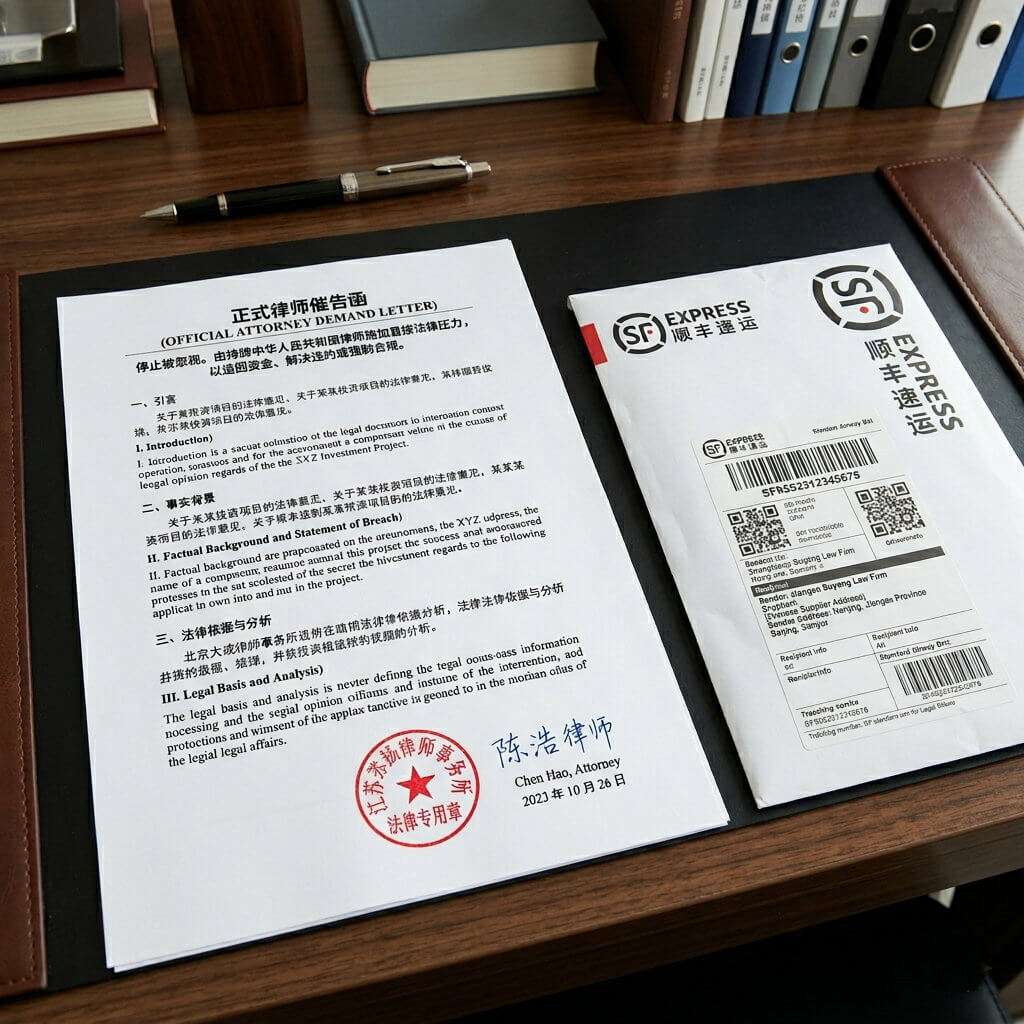
Organize the contract, invoice, payment trail, promised milestones, and communications to establish what was due and what remains outstanding.
Document specifications, inspection results, photographs, rejection notices, and the contractual remedy before framing a demand.
Verify the debtor entity and trace written acknowledgements, refund commitments, and payment deadlines instead of relying on informal promises.
Confirm the legal entity, registered contact details, and evidence trail before choosing notice language or considering a broader recovery assessment.
Match the Chinese legal name, contract party, invoice issuer, and payee so the demand is not directed to the wrong entity.
Identify the contractual duty, breach, amount, chronology, and requested cure from primary documents and communications.
Select the claims, response deadline, delivery route, and escalation language appropriate to the reviewed facts and jurisdictional limits.
A response, non-response, or disputed fact may change the next step. Litigation or recovery assessment remains a separate decision.
Work layer: Public scope explanation Confirmed on this page: Questions, documents, workflow, limits, and an inquiry route Confirmed only after assessment: Specific professional engagement, fee, timing, and responsible people
Work layer: Starts with client and public material Confirmed on this page: Facts to verify and gaps to resolve Confirmed only after assessment: Admissibility, translation, notarization, or specialist opinion for a formal procedure
Work layer: No outcome guarantee Confirmed on this page: A framework for the next assessment Confirmed only after assessment: Payment, settlement, victory, enforcement, compliance, or closing result
These scenarios explain the assessment method; they are not client cases, outcome claims, or legal conclusions.
The assessment would focus on entity identity, payment evidence, production commitments, cancellation terms, and written admissions. This is a scenario, not a claimed client outcome.
A useful record may include specifications, inspection method, defect evidence, notice timing, and the remedy stated in the contract. Technical proof may still be required.
Preserve the written acknowledgement, amount, schedule, bank details, and every missed deadline. The demand can state a clear position but cannot ensure payment.
No. It is a pre-litigation communication. Court filing, service, evidence rules, and enforcement are separate procedures.
No. A demand may clarify the claim and create a formal response opportunity, but it cannot guarantee payment, settlement, or compliance.
Prepare the contract, purchase order, invoices, payment proof, specifications, inspection material, delivery records, and relevant communications.
Trading names, affiliates, and payees may differ. Correct entity identification is essential before any formal notice or recovery step.
No. Evidence and scope must be reviewed before any fee or professional engagement is confirmed.
The next step may be negotiation, further evidence work, or a separate recovery and litigation viability assessment.
Submit the entity, documents, amount, chronology, and decision you need to make. Facts, scope, and applicable requirements must be reviewed before any professional engagement, fee, or timing is confirmed.
Send an inquiry